diagrams from your data model
architecture diagrams drift because they’re drawn by hand. the ones
in this post are emitted from the same model that drives the fabric.
text-first, diffable, regenerated on every
run.cargo install alembic-cli
last year, i wrote on my personal blog about what makes an architecture diagram worth keeping. i wrote that it should be generated from real data, text-first so you can diff it, and regenerated whenever the architecture changes, because a hand-drawn diagram drifts from reality faster than you can say change management. i won’t make the argument here again.
instead, this post talks about the other half and dives into the practice. alembic is a tool for your fabric, but also emits diagrams exactly the same way, from the same model, because it can.
a diagram is just another output
alembic holds your fabric as a vendor-neutral model, and it converges that model onto backends like netbox or containerlab. a diagram doesn’t need anything more. it’s the same objects, emitted into a different shape. so an emitter is wired up like any other backend, through the external-adapter interface we talked about last month:
backend: external
command: alembic-adapter-mermaid
setup:
  out_path: ./out/topology.mmd
  title: fra1 fabric
  group_attr: role
point it at the fabric, run the emit, and you get a mermaid graph with nodes grouped into per-role subgraphs and every link labeled with the interface pair it connects:
---
title: fra1 fabric
---
graph TD
    subgraph leaf["leaf"]
        leaf01["leaf01"]
        leaf02["leaf02"]
    end
    subgraph spine["spine"]
        spine01["spine01"]
        spine02["spine02"]
    end
    spine01 -- "eth1 <-> eth1" --- leaf01
    spine01 -- "eth2 <-> eth1" --- leaf02
    spine02 -- "eth1 <-> eth2" --- leaf01
    spine02 -- "eth2 <-> eth2" --- leaf02
rendered, it might look something like this:
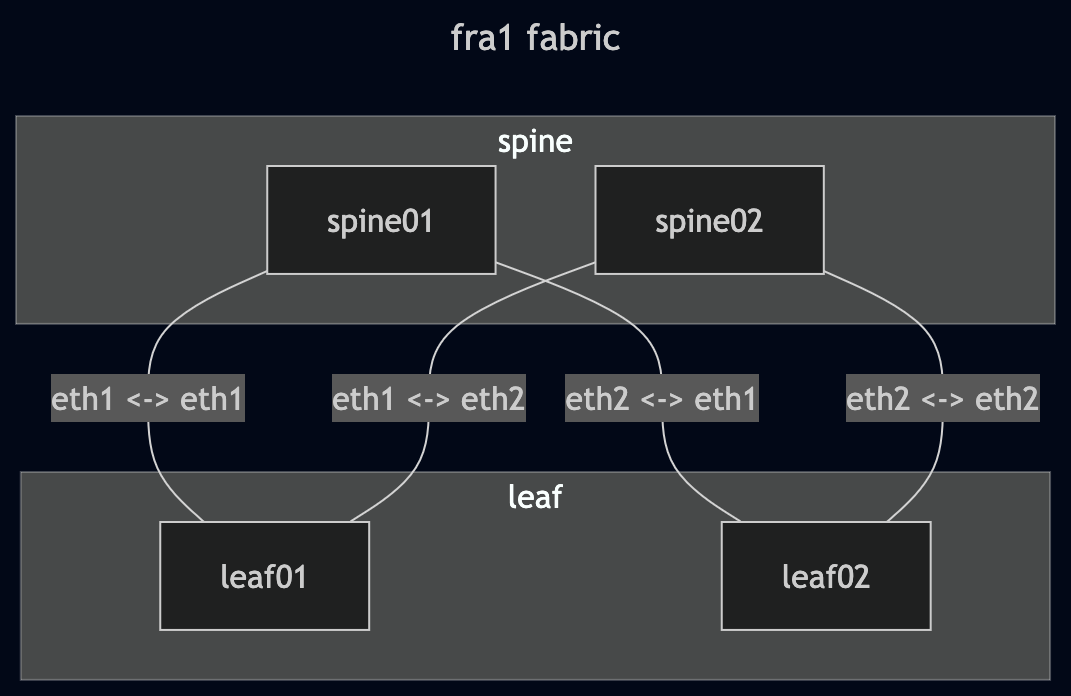
a second view, same source
no single diagram captures a system, so it helps to emit more than one. the same fabric through the graphviz dot emitter, which styles nodes per role instead of grouping them:
backend: external
command: alembic-adapter-dot
setup:
  out_path: ./out/topology.dot
  name: fra1
  style_map:
    spine: { shape: box,     color: "#1f77b4" }
    leaf:  { shape: ellipse, color: "#2ca02c" }
and again, the output speaks for itself:
graph "fra1" {
    "leaf01"  [label="leaf01",  shape="ellipse", color="#2ca02c"];
    "leaf02"  [label="leaf02",  shape="ellipse", color="#2ca02c"];
    "spine01" [label="spine01", shape="box",     color="#1f77b4"];
    "spine02" [label="spine02", shape="box",     color="#1f77b4"];
    "spine01" -- "leaf01" [label="eth1 -- eth1"];
    "spine01" -- "leaf02" [label="eth2 -- eth1"];
    "spine02" -- "leaf01" [label="eth1 -- eth2"];
    "spine02" -- "leaf02" [label="eth2 -- eth2"];
}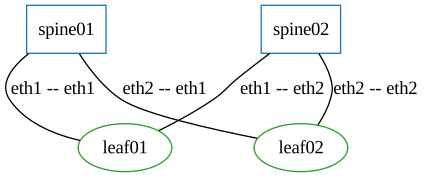
two views of one fabric, spines as blue boxes and leaves as green ellipses. it won’t win on prettiness, but accuracy is a given.
as a bonus, the diagram remains data.
why?
both outputs are text, so they diff cleanly in a pull request: when we add a leaf, the diagram gains exactly the lines for that leaf. both are a function of the model, so they can’t say something the fabric doesn’t. you can generate it as part of your deployment process and keep your documentation up to date.
in my personal post i argued exactly that this is what i like to see when i audit or do due diligence. a diagram that is generated, text-first, and regenerated on change. if i do a security workshop with you, i’ll take that over a diagram that’s pretty but wrong any day.
mermaid and dot are two shapes we support, but they don’t have to be the ones you use. the diagram emitters shown here are part of the paid alembic-ops layer, but in the end they’re just external adapters speaking the open protocol from last month’s post. a diagram emitter of your own shape is an afternoon with the free sdk. no private fork required.